DIY Card Scraper From Old Credit Cards

image Credit card companies such as Chase and  American Express have been adding metal to their cards as a gimmick. I had a few old credit cards that have metal piece inside them. Sometimes when you get a new one, the card company sends you an envelope to return the old ones in for recycling, or they suggest you use tin snips to destroy them.  I found a better use.

In woodworking, many times in order to get a nice smooth surface, you might use a card scraper, which is just a thin steel card with sharp edges. You hold it roughly perpendicular to the surface of the wood and draw along the surface perpendicular to the flat side of the card.  This shaves a very thin layer off the top of the wood.

You could buy some card scrapers, but since I had these extra credit cards, I tried to make some myself. I attempted a few different methods to remove the plastic form both sides of the cards. Firstly, went in brute force and pulled the plastic off both sides. As the edges of these cards are sharp without the plastic, I gave myself a pretty good gash in my thumb. This is not a great method. 

For the second card, I attempted to melt the plastic with acetone…. which didn’t fully work and made a nasty, stinky mess.

The third attempt, I went in the garage and used a little torch to heat up the plastic on the card.  Once I saw that it could work, I stopped.  I recommend doing this completely outside with the garage door shut.  Of course use some pliers to hold the card.  This method could work well, but just be sure not to heat the metal until it changes color. You can then clean off the melted plastic blobs with a flame retardant sacrificial rag.

The end results work great!  I also punched out the tiny SIM card in mine, but you can leave it in. It is potted with clear epoxy so you can see the chip and gold connection wires on the back side if you leave it in which is pretty cool.
Simple Tissue Box DIY Christmas Presents

Each year, Jess and I make crafts as Christmas gifts for family members.  This year, our first idea was too hard (as is typical) but we had another project we had wanted to do as well that worked out great!.

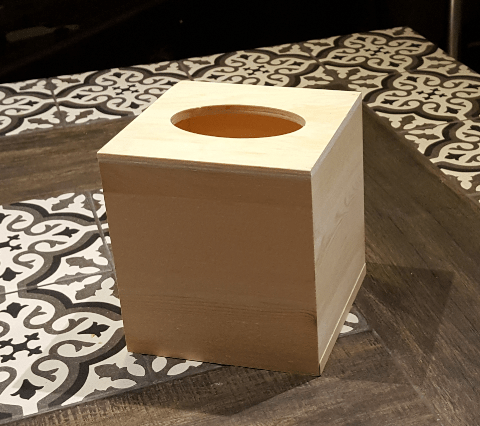
Firstly, we got some wooden Tissue Box covers.

emptyBox

The next step was to get a gel stain. We reused the same stain we used for our ukulele project which goes a long way.

We then used our KNK Zing vinyl cutter to cut a vinyl sticker Jess designed as a template to help up print a design on the boxes.  We placed our clear transfer paper on the box and drew the outside dimensions to help us align the design.


tempalte3template

When placing this on the actual box, it helps to hold it up to the light so you can see the edge of the box well.

lightlight2

When we ran out of large pieces, we cut the designs on scrap vinyl and pieced it together on the transfer paper. Here’s an example:

tempalte 4


Once we had all the templates set up. We removed the clear transfer vinyl and used a dark gel stain and a foam brush to blot the stencil.

staining

This was left for about an hour to dry until tacky and then we removed the stencils.

weeding

We then left the stain to dry completely overnight.

before

We finished the boxes with a light coat of white gel stain. The trick is to paint it on with the foam brush, then wipe off excess with a nice paper towel (This brand of paper towels are best for these kinds of crafts as they don’t leave any fuzzy mess behind).  Do this technique to all sides of the box, even if they don’t have a stain design.  This gives a rustic whitewashed look that still shows the figure in the wood a bit and evens out the design overall, making it look completely finished and cohesive.

Wipe on:

afterPaint

and wipe off:

wipe

Telescope Counterweights

For some time now I’ve been interested in astrophotography, but my camera hanging off the back of my scope was too heavy for the clutch. The camera just weighted everything down. The solution is to add weights to the tube. You can buy a super expensive kit, but why do that when you can slap together a junky version yourself for much cheaper?

I ordered 24” of Mini T-track  which can fit a 1/4” bolt head.  When it arrived, I measured (by eye) the mini t-track against the side of my scope. I cut it leaving a short piece (which will be used later) and the actual weight section.  I marked the two holes where the screws on the tube were. These are the screws that will hold the t-track to the tube. I actually drilled with two bits.  One just the right size for the screws to pass through, and then I used another larger bit to remove the material from the top of the T-track and countersink the screws a bit. What isn’t shown below is a larger hole made in the top of the T-track so that I can easily add or remove weights without having to take the track off the tube.

rail1

I unscrewed the two bolts from my scope tube along the bottom. The whole time praying I don’t get any nasties in the tube during this escapade…

scopeHOle

As for the weights, I used some 2” long 1/4” bolts and a 100 pack of 1.5” fender washers as weights.

I honestly didn’t count or measure the weights out, I just made a couple larger stacks of washers and a couple shorter ones. I used standard 1/4″ nuts as lock nuts to hold them on, though I wish I would have sprung for a cheap T-track knob set like this one which would make them easier to move around with one hand while I’m aiming and wrestling with the scope..

weights1

That little left-over piece of T track was great for a top-mount for a camera. I drilled a hole in the middle for the tube screw and added a great little folding tilt mount for a camera.

top1

I used a really short 1” long 1/4” bolt to mount it.

top2        top3

Now I can put a camera on top as well as having a camera at prime focus of the scope. This can be used as a guide camera with a tracking program like PHD2 or another DSLR to take some additional wider-angled and less zoomed pics.

UPDATE: to make the weights not look so janky, I added thumbknobs and 3d printed black plastic sleeves for them. You can find the 3d printer files here to make them yourself.

Adding USB Power Ports for TV Accessories

outletsThe number of USB-powered devices around my TV has drastically increased over the last few years. With a Roku, Google Chromecast (requiring external power) and an amazon Echo dot or google home, and even sometimes to charge a phone, I felt like the wires were a mass of black spaghetti in my TV area. To fix this, I decided to replace the power outlet with one that incorporates USB power.   I was sure to get one rated for as many amps on the output as possible to future-proof the whole setup and also to quick-charge my phone if I needed to.

The tools used were a small ratchet screwdriver set (not pictured), l, Wire Strippers/cutters (these from HanLong tools are the best I’ve ever used) and a non-contact AC voltage detector. If you can’t find the screwdriver set, just make sure you get a flathead and a phillips head screwdriver.

wall Tools

The first step is to turn power off at the breaker box!  To check that you turned off the correct breaker, use the AC voltage detector by simply inserting it into each plug of the receptacle. If it flashed red and blinks repeatedly, then you didn’t turn off the right breaker.  This is an important test because many time breaker boxes are labeled correctly, or for some reason the builder wired some lights or sockets to other breakers but never noted it on the breaker box.

Once the power is turned off, remove the front plate of the current outlet with a flat-head screwdriver. Why the hell they chose to make this a flathead screw, which can easily slip and cause you to jam your screwdriver into the outlet alludes me. That’s just bad design! Then you can use the phillips-head screwdriver to remove the outlet by unscrewing the screws at the top and bottom of the outlet.

Pull out the old outlet and I had to cut off the wires.  Inside this box should be 3 colors of wire. The bare copper is the ground wire. That safely handles the power in case of a short circuit, shunting it to ground. Then you should have a white wire which is considered “Neutral” and either a Red or Black wire. Sometimes you’ll have both red and black wires.  These two are the “Hot” wires. what you may not know is that the white Neutral and ground wires are connected together at the breaker box, but the red and black wires are two phases of 120v each.  They use these together in multiple areas of a house such as a ceiling fan where one wall switch controls the light and the other controls the fan, or to wire things like your oven or dryer which needs 220v.  The first thing to do is always wire the ground wire up.  There’s no hard and fast rule about it, but it’s the order I like to do things. In this case you simply use a straight end of the ground wire and clamp it behind the brass plate where the green screw is on the outlet. The green screw on this kind of stuff is always ground.

wiring Gnd

Then move on to the actual power wires. In our case, I had what looked like 4 white wires.  I pulled them out of the box a bit so I could see what was going on. The painters had been messy and painted the black wires white. I scraped a little paint off and then wired them up. You can follow the instructions on your new outlet for how to do this. In my case, I stripped about 1/2” of the insulation of the solid core wire, pushed it into the appropriate holes (labeled “hot” and “neutral” on the outlet) and screwed in the screws on the sides to clamp these wires in place. If you have both red and black wires in your box, do not wire them both to “hot” like I have. You need to read instructions for your particular outlet to see what to do with those. You may be able to just terminate one of these with a wire twist cap and electrical tape. I’m not sure what the building code says about that.

wires

Once you are done, carefully shove all the wires back into the box and screw the box into place. This outlet is a bit bigger than the original one I had, so I had to fiddle with the ground wire connectors and wires to fit it all in the box. Once the outlet is secure, put the new faceplate on and you

are ready to turn the breaker back on and test it.

finished outlet

You can see the before and the after results of how this can clear up the mess of wires visible in the TV nook.  You may also want to use zip ties or better yet, velcro strips to tidy wires p even more so.

Before:                                                                                          After:

TVbefore                               after

Our Top Picks from the Etsy Design Awards #TheEtsies

For the first time ever, Etsy is running a global award program: The Etsy Design Awards. There are 160 global finalists that fall into one of the following five categories for #TheEtsies: Inventive Decor, Signature Style, Festive Celebrations, Earth-Friendly, and Creative Collaborations. We’ve done round-ups on favorite toddler products, but this is our first Etsy round-up.

Here are our top picks from #TheEtsies!

My Picks:

My top 5 choices represent items that inspire me to buy from Etsy or make myself.

minimalist wall calendar from Etsy seller

Calendar Wallplanner from the shop WiLaNo (Inventive Decor Category)

paint your own photo backdrop

Custom Painted Photo Backdrop by the shop thesmallcreative

stylish pegboard organizer for your home

Monstera Leaf Wood Pegboard Organizer by the shop littleanana

I think this makes a perfect jewelry organizer, although I think I’d rather have the larger version (it’s almost twice as big!). I love the versatility of the moveable pegs. The dinosaur pegboard would also be a great addition to a child’s space. My daughter would love it in her room. Plus, I’m game for anything that will encourage my kid to clean!

custom family paper portrait

Paper Cut Custom Portrait by the shop PurplePaperPeople

minimalist wood dollhouse for etsy design awards top pick

Large Modern Dollhouse “The Milky-house” by the shop MilkyWood

Well, we already made a dollhouse for our daughter with our CNC machine. But, if we hadn’t already done this ourselves I would totally buy this modern dollhouse.


Adam chose his ideas independently of me, and all his picks were different except one. He also picked the dollhouse! I chatted with him for his reasoning behind his picks. This is what he had to share:

Adam’s Picks:

My top choices are designs I appreciate in terms of their form, function, and material choices.

eco-friendly lamp

ECOWOOD Table Lamp by shop TedzukuriAtelier

This lamp uses an interesting recycled veneer from a banana’s plant trunk.

Paper cutting your house diy

Custom House Portrait by shop yeiou

The use of white paper for a 3d representation of your home results in a minimalist, elegant design. This would make a great anniversary gift for parents.

Cat house for Etsy design awards pick

Designer Cat House by PetsandPods

I feel like my cats would crawl into this immediately. It’s a cat bed you don’t mind having in a prominent location in your house.

succulent ring dish

Succulent Wedding Ring Holder by shop Waen

This ring dish stands on its own as decor, with or without a ring.

special wooden ring box for gift or proposal

Diamond shape engagement ring box by Woodstorming

Woodworking is one of my hobbies, and I like the movement of the lid on this uniquely shaped ring box.

From design inspiration to must-haves for your home, this round-up features a variety of designs. These top Etsy design awards picks for this year are based on our current tastes, which are ever-changing.

So, what is your favorite ETSY nominee for #TheEtsies and why?

Protected by CleanTalk Anti-Spam